
AI workflows for Australian professionals
Let the work flow. Keep the judgement.
We build the AI workflow around a job your firm repeats — a client reply, a document check, a marketing video from a brief. Client details are swapped for placeholders before anything is routed, a named person approves the result, and every run leaves a record.
- Built in Australia
- Identifiers replaced before anything is routed
- A record of every run
From “someone should do that” to drafted, waiting on you.
- Client replies
- Document checks
- Approvals
- File notes
- Invoice chasing
- Marketing content
- Campaign videos from a brief
Where the time goes
How a repeated job gets done today.
Six steps, by hand, by whoever picks it up. The third is the one that gets skipped on a Friday afternoon.
- A request, document or brief arrives
- Someone finds the file or the context it refers to
- Details that should not be sent are taken out by hand
- A draft is written with help from an AI tool
- Someone senior checks it before it goes
- A record gets written, or does not
With the workflow
The same job. Four things change.
- The draft is waiting before anyone opens the requestThe workflow starts when the request arrives. Nobody presses go, and nobody has to watch it run.
- The details come out automaticallyClient identifiers are swapped for placeholders every time, not only when someone remembers to.
- The result stops at a named approverApprove, ask for changes, or discard. Nothing is sent or published until someone has said yes.
- The record writes itselfWhat ran, when, under which policy, who approved it. Never the content.
Beyond the chat window
Five steps, run the same way every time.
A dependable system around the model, rather than a blank prompt box and a hope that everyone uses it the same way.
A defined task
The firm decides the job once. Everyone runs the same one.
Identifiers out first
Client details are replaced with placeholders before anything is routed. Designed to reduce what leaves.
An agreed model
Each job runs on the model agreed for it. Change that later without rebuilding the workflow.
A named approver
Review is declared in the workflow, where the workflow calls for it — not left to whoever is driving.
A record of the run
Metadata only — what ran, when, under which policy, who approved it. Never the content.
The workspace
What your team actually sees.
Four screens from one job: the work waiting, the details coming out, the decision that belongs to a person, and the record it leaves behind. Scroll through — each one opens up as it reaches the middle.
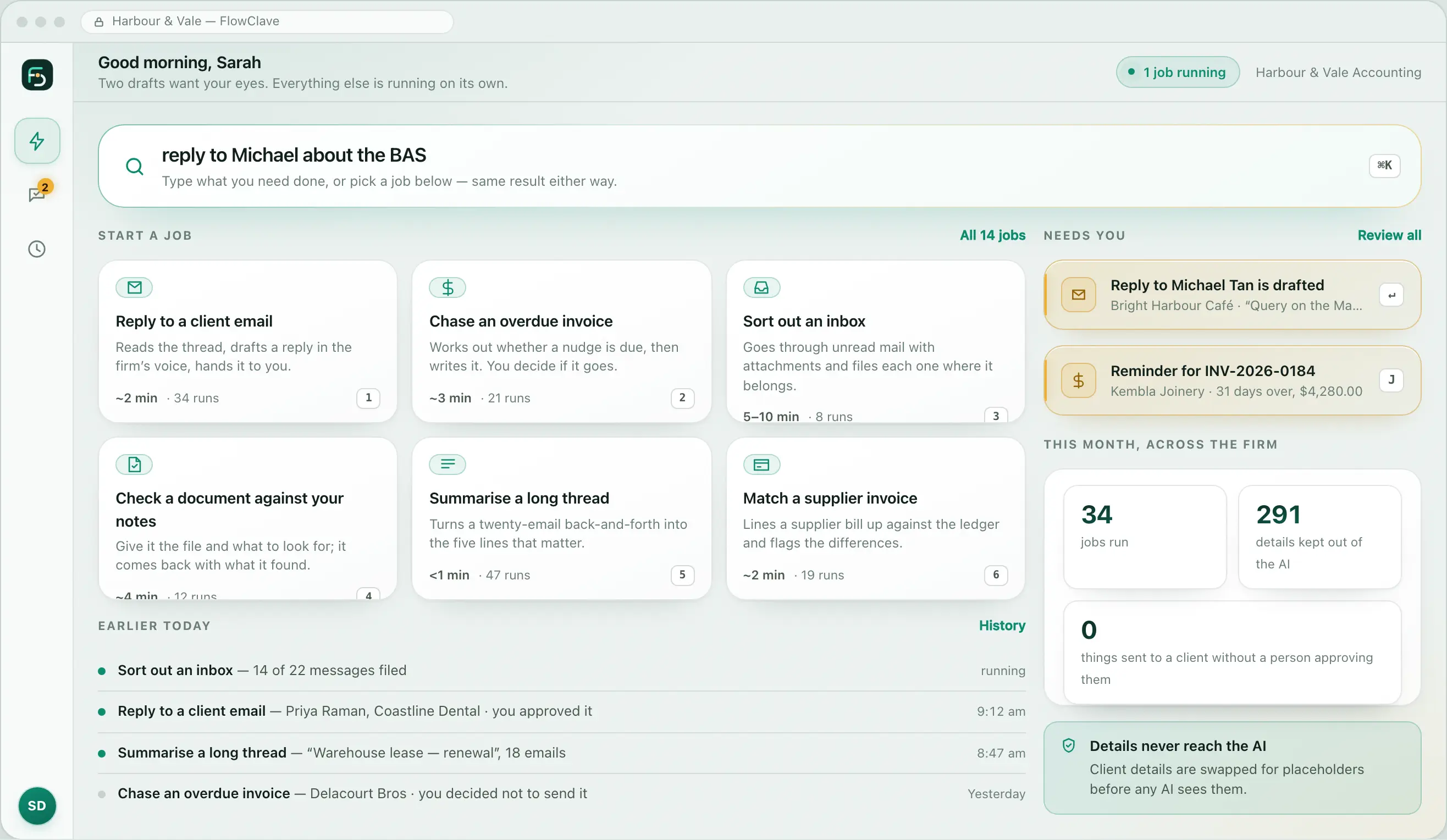
HomeThe jobs this firm runs, what is running now, and what is waiting on a person. 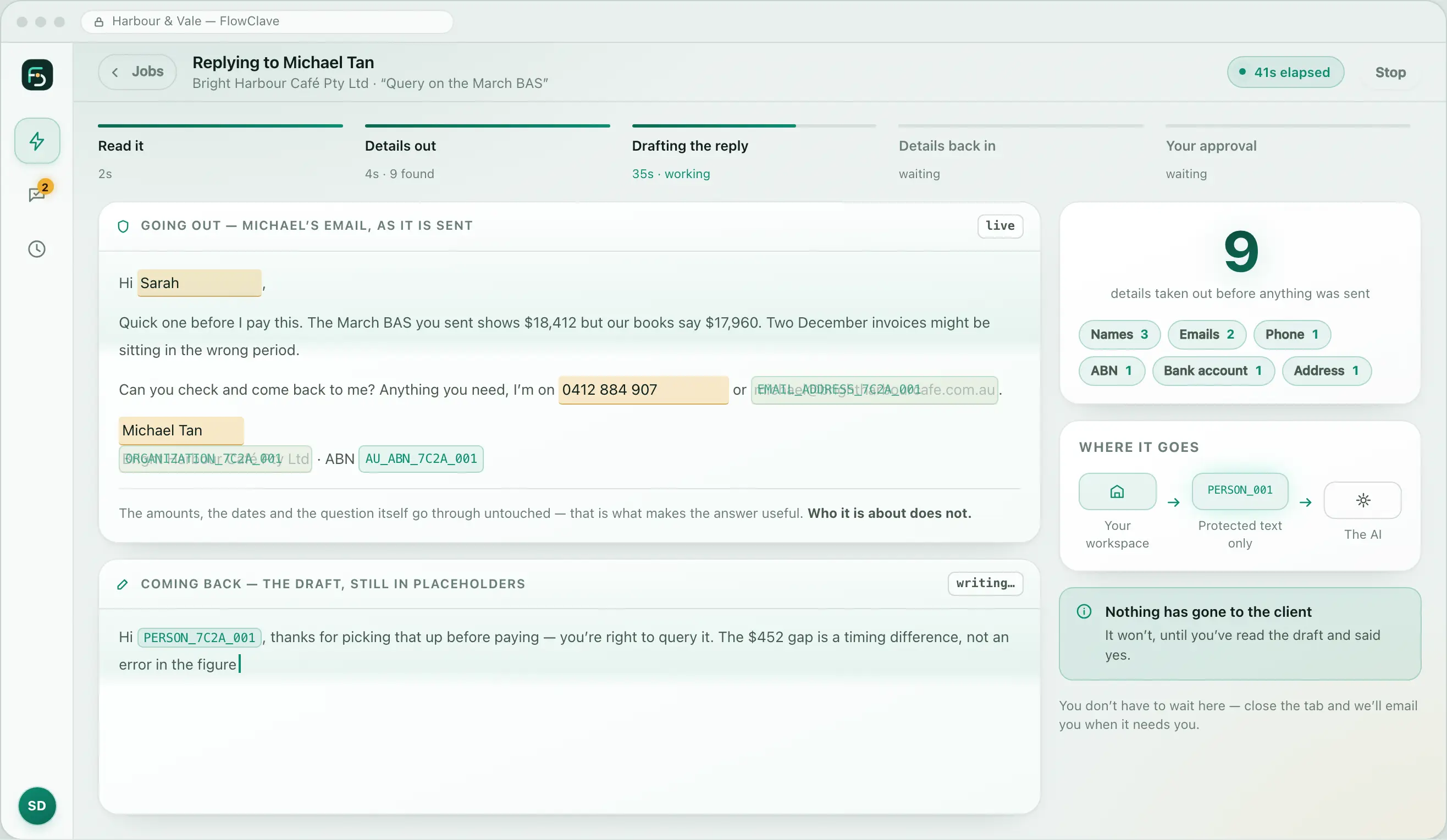
RunningThe details leaving the text, live, and the draft coming back. 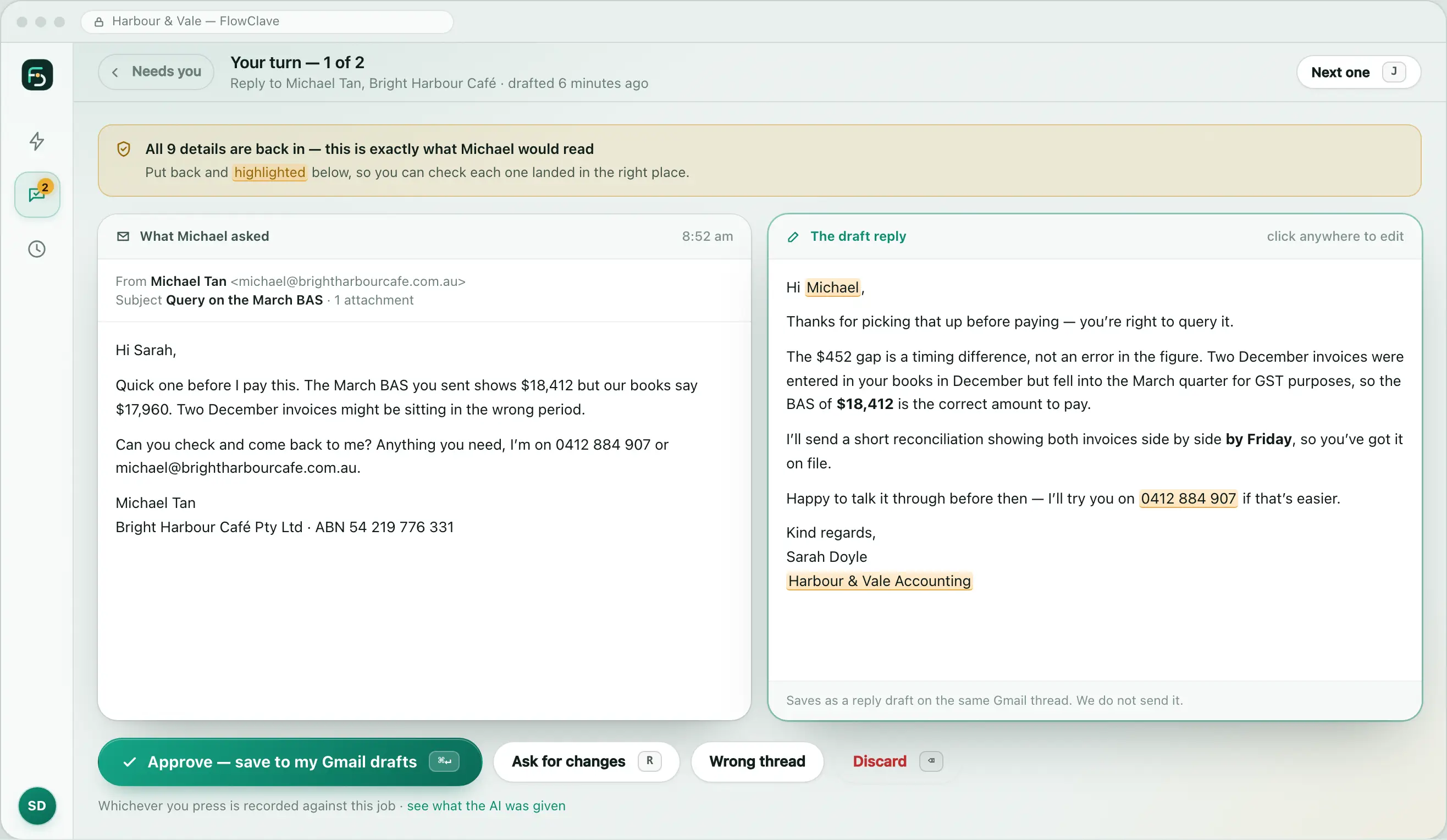
Your turnThe draft with every detail put back, next to what the client asked. 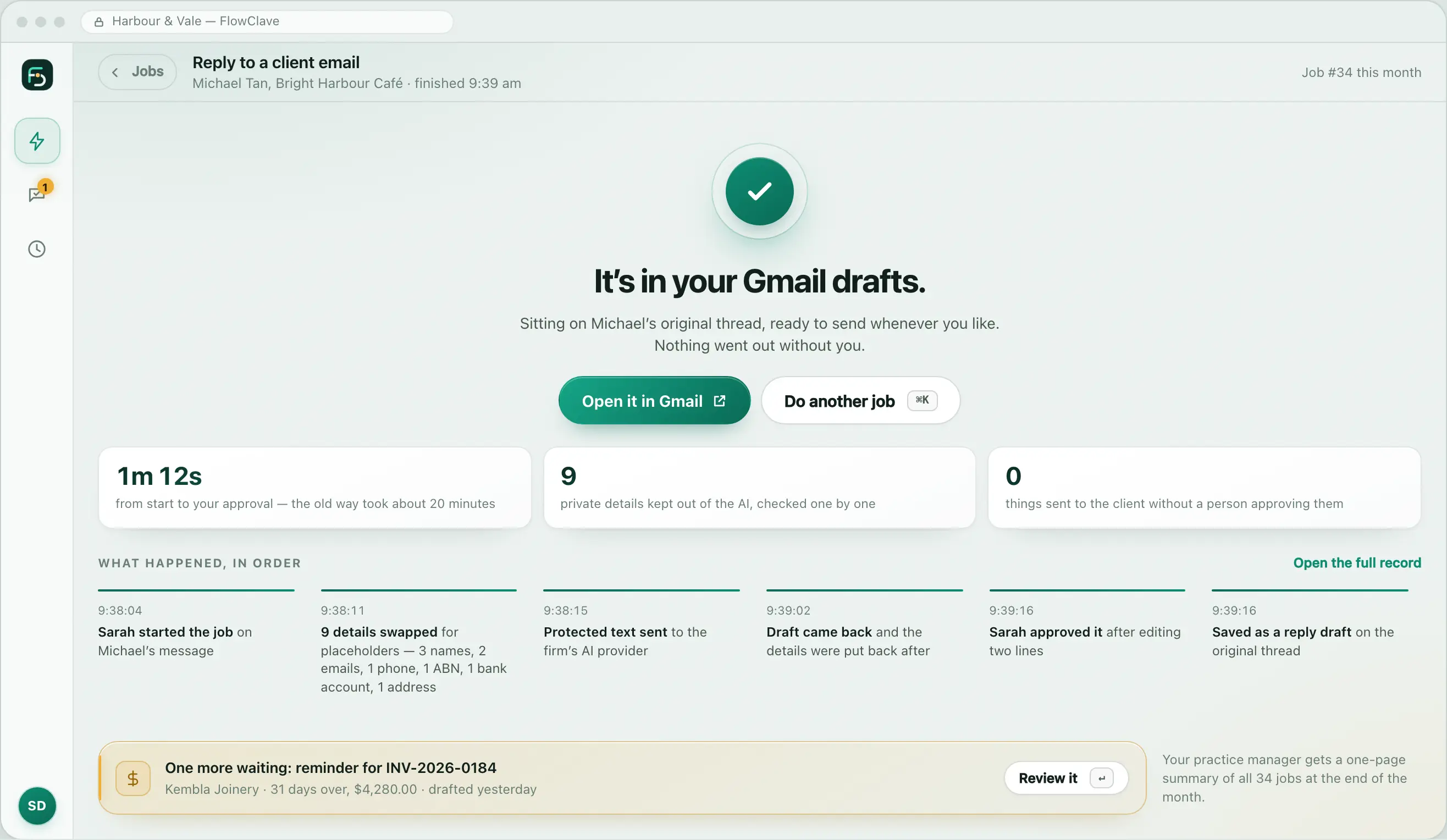
DoneWhere the result went, and the record of what ran and who approved it.
Interface design, shown with invented sample data. The firm, the clients and every figure on these screens are made up.
What professional bodies have said
Four things they keep saying about AI.
Tax, legal, credit and health bodies in three countries, each in its own words. None of them banned it. Read the quotes, dated and linked.
The duties you already had attach to the AI output
None of these created a new rulebook. Each says the obligations already in force apply to work done with AI, in the same terms.
Someone has to check the output
Verification appears in every one of them, and in two it is said explicitly that the checking cannot be delegated back to the same kind of tool.
Responsibility does not move
The practitioner, licensee, or firm stays accountable for the result, whatever produced it. Nothing here treats a tool as a party that can carry blame.
Be able to show what happened
The artefact being asked for is shifting from a policy that says what a firm would do, to a record of what it actually did.
End-to-end delivery
One team, from bottleneck to live workflow.
- 01MapFind the friction and define the win.
- 02BuildEngineer the workflow around your rules.
- 03FitSlot it into your existing handoffs and tools.
- 04ImproveRefine it with the people doing the work.
Where it is already built out
Some professions have more built than others.
The five steps run whatever the document or brief is. What has actually been built differs by profession, and each page says so plainly — including where the honest answer is not much yet.
See who it is forStart with one workflow
It starts with one conversation.
Bring the job your team is tired of doing — a client reply, a document check, a marketing video from a brief. In 30 minutes we map what happens now and where the workflow belongs. You keep the one-page map.
Book your free workflow map- 30 minutes
- No preparation
- Written map included
If it is worth building, the next step is a fixed six-week build at A$2,500: one workflow, your team, weekly refinement and a written before-and-after.
Good to know
A few quick answers.
What should I bring?
One job your team repeats regularly. A client reply, a document check, a file note or a marketing video from a brief are all good places to start.
We already use ChatGPT. What is different?
The job is defined once and runs the same way for everyone. Client identifiers are replaced before anything is routed, a named person approves the result, and a record of the run is kept. A chat window does none of that on its own.
Can it help with marketing as well as client work?
Yes. A brief goes in, campaign videos or content come out, and someone approves them before anything is published. The same five steps apply.
Do we need to choose the AI first?
No. We start with the job, then select and configure the right tools around it.
Does it replace the software we already use?
No. It sits alongside the practice, email and marketing tools you already use rather than replacing them. The map works out which handoffs it should touch first.
What happens after the map?
If the opportunity is worth pursuing, we scope a fixed six-week build. You decide whether to proceed.