
Our primary focus
Accounting and tax practices
Our primary focus. Client correspondence, document summaries and file notes are done over and over by roughly the same steps, which is exactly what a defined workflow is built for.
The job we would time first
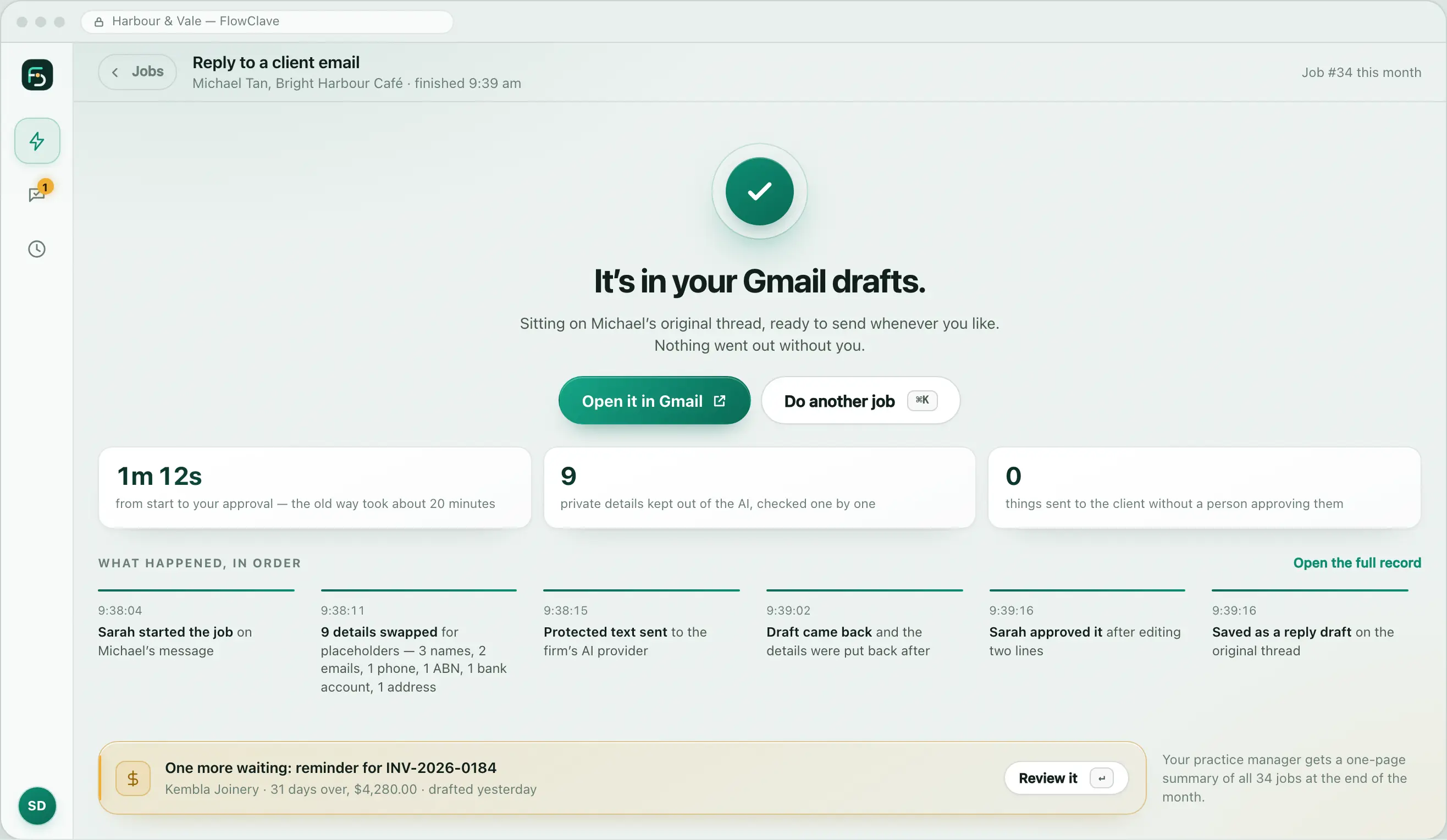
One inbound document, end to end
Every design partner times the same shape of job, varying only the profession. That is deliberate: it tests whether the mechanism saves time independently of industry, which is a more useful thing to learn than two data points in one profession.
- ATO correspondence
- Client email drafting
- Document and evidence summaries
- Tax file notes
- Overdue invoice chasing
- A client email or document arrives
- Someone finds the file it refers to
- Details that should not be sent are taken out by hand
- A draft is written with help from an AI tool
- Someone senior checks it before it goes
- A file note gets written, or does not
How it lands here
What this looks like in your practice
Client correspondence, document summaries and file notes all share one shape: something arrives, a draft goes out, someone signs it off. That is exactly what a defined workflow is good at, and it is why we started here.
We build the workflow around a job you already run, rather than handing you a catalogue to choose from. One job, defined properly, is worth more than six half-configured ones.
In your regulator's words
What has already been said about this
Quoted from the published documents, with dates and links. We have not summarised them for you, and none of this is us telling you what your obligations are.
tax practitioners are still ultimately responsible for the tax agent services they provide to their clients. It is important for tax practitioners to understand the capabilities and limitations of AI tools, and ensure AI outputs are assessed and supplemented by professional judgement, before being relied on.
Tax practitioners should verify and review AI generated content for accuracy throughout each step of the workflow and should establish processes to understand and contest AI decisions/outputs. Each of these steps should be documented.
Do not upload client data into a public-facing AI tool like ChatGPT. Uploading client data into in-house AI tools is acceptable, as long as they possess adequate privacy and security attributes.
One job, defined once
Bring one job your practice repeats
Thirty minutes, no software shown, and a one-page write-up of that job whether or not you take it further.